Cooler temperatures, shorter days, and reduced evaporation let organic lawn care inputs work harder per dollar spent. The aggressive top growth of summer has slowed, so nutrients get directed into roots instead of leaf blades. For anyone managing buffalo, couch, or kikuyu, that shift in growth priority is exactly what organic programmes exploit.
Organic lawn care refers to maintaining turf using inputs from natural sources instead of synthetic chemical fertilisers and herbicides. Think compost, seaweed extracts, fish hydrolysate, bone meal, and humic acids. The goal is feeding the soil food web, the billions of microorganisms that convert organic matter into plant-available nutrients.
Why Autumn Outperforms Spring for Organic Inputs
Organic products rely on microbial activity to convert raw ingredients into forms grass roots can absorb. Soil temperatures between 12°C and 22°C hit the sweet spot for this conversion. That’s precisely where most Australian regions sit through autumn.
In spring, soil temps are climbing from cold winter lows. Microbial populations haven’t fully rebuilt yet. Autumn flips the script: populations sit at their annual peak after a full summer of warmth.
That timing matters because slow-release organic fertilisers applied in April or May can take two to six weeks to break down. In spring, when microbes are sluggish, much of that product sits inert in the soil. Field experience shows autumn applications begin releasing nutrients within days. Roots get a genuine feed before winter dormancy sets in.
There’s another angle most guides miss. Warm-season grasses store carbohydrates in their stolons and rhizomes during autumn. They’re building energy reserves they’ll draw on to green up the following spring. A well-timed organic feed supports this storage phase directly.
Skip it, and the lawn enters winter running on empty.
Adjusting Mowing Height Before Winter

Raising the mower deck by one notch (roughly 10-15mm higher than the summer setting) gives the lawn a measurable advantage. Taller leaf blades capture more sunlight during shorter days. That supports photosynthesis and continued carbohydrate production heading into cooler months.
- Turf professionals typically recommend a final autumn mowing height of 50-60mm for buffalo and 30-40mm for couch or kikuyu.
- Cutting too low in late autumn exposes the plant’s crown to frost damage in southern regions.
- Leaving clippings on the lawn (grasscycling) returns nitrogen and organic matter to the soil surface, acting as a free top-dress.
- Mowing frequency can usually drop to fortnightly or even three-weekly by late May.
One mistake that comes up repeatedly is scalping the lawn in autumn. Scalping has its place in early spring for warm-season grasses. Doing it in autumn strips away the insulating canopy right when the plant needs it most. Recovery the following season takes weeks longer.
The Role of Seaweed and Liquid Biologicals
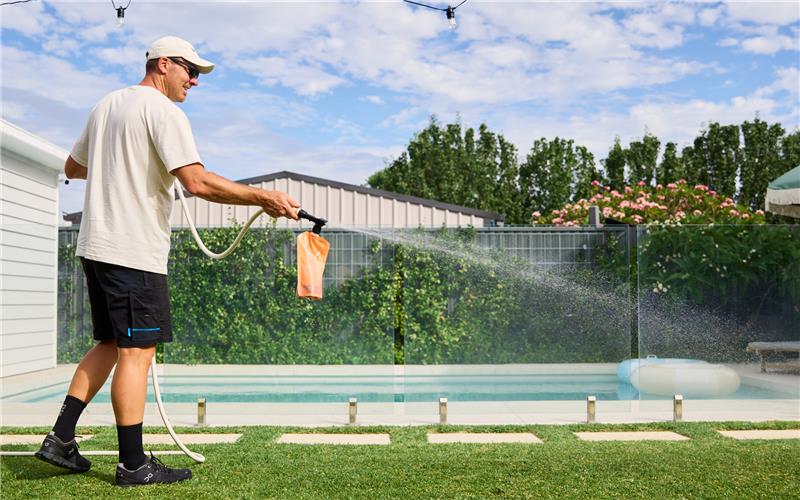
Liquid seaweed extract is one of the most underrated tools in the organic toolkit. Applied as a foliar spray or soil drench in early to mid-autumn, it doesn’t function as a traditional fertiliser. Its value comes from plant growth hormones (cytokinins and auxins), trace minerals, and its ability to stimulate root development.
- Seaweed-treated turf has shown improved frost tolerance in field trials. This matters for lawns in Victoria, Tasmania, the ACT, and elevated parts of New South Wales.
- Application rates vary by product. A general guide is 10-20mL of concentrate per litre of water, applied via a hose-end sprayer.
- Two applications spaced three weeks apart tend to produce better results than a single heavy dose. Early April and late April is a solid schedule.
Humic and fulvic acid products pair well with seaweed treatments. They improve nutrient uptake efficiency in the root zone. They also help sandy soils hold onto cations like calcium, magnesium, and potassium that would otherwise leach after rain.
Frequently Asked Questions
Is It Too Late to Start Organic Lawn Care in Late Autumn?
It’s not too late, though the window narrows as temperatures drop below 12°C. Microbial activity doesn’t cease entirely until soil temps approach single digits. Starting with a compost top-dress and a seaweed application gives the lawn a solid foundation heading into winter.
Can Organic Lawn Care Fix a Lawn That’s Already in Poor Condition?
Organic inputs improve turf over multiple seasons rather than delivering overnight results. A thin or patchy lawn will benefit from compost, aeration, and overseeding in autumn. It typically takes two to three full seasonal cycles before the soil biology reaches a self-sustaining state.
Does Organic Lawn Care Cost More Than Conventional Products?
Initial costs can be slightly higher on a per-application basis. Organic fertilisers tend to require more product volume. Over a 12-to-24-month period, total costs often even out. Healthier soil reduces the need for pest treatments, fungicides, and excessive watering.
What’s the Best Organic Fertiliser Type for Autumn in Australia?
A slow-release granular fertiliser with moderate nitrogen and added potassium suits most autumn applications. Potassium strengthens cell walls and improves cold tolerance, which is exactly what turf needs before winter. Products based on composted poultry manure, seaweed, or fish meal perform well across most Australian soil types.
Closing Thoughts
Autumn lawn care isn’t glamorous. It doesn’t produce the instant visual payoff that a spring feed delivers. But the work done between March and May determines how a lawn looks and performs for the entire following year.
Organic inputs applied during this window feed the soil ecosystem at its most receptive. They build root reserves and suppress weeds without chemical intervention. Turf that enters winter with strong roots, balanced nutrition, and a thick canopy comes back faster and greener when the warmth returns.