Commercial evaporative coolers get chosen on site conditions, with brand and brochure specs coming much later in the process. Local climate alone can decide whether a unit performs well or barely makes a difference.
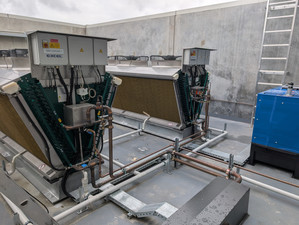
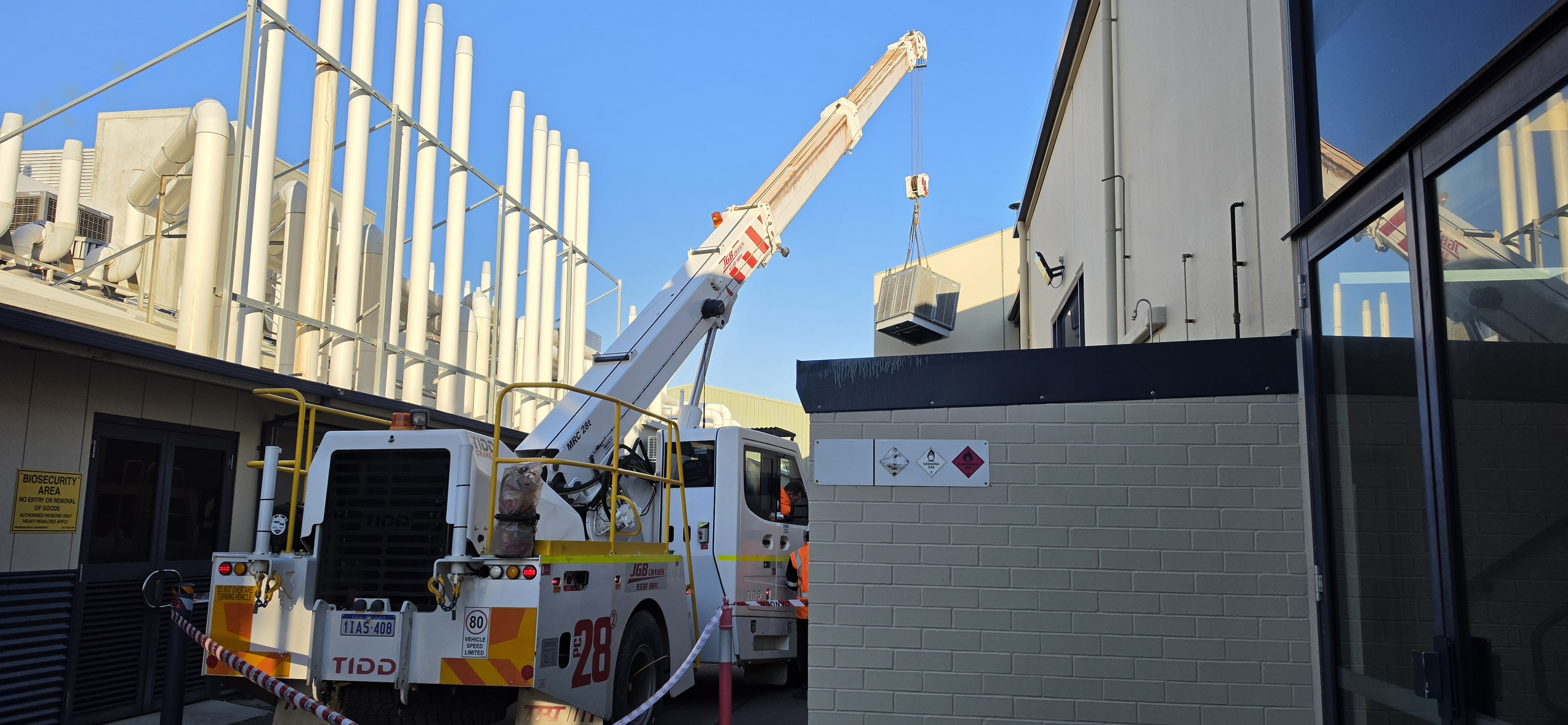
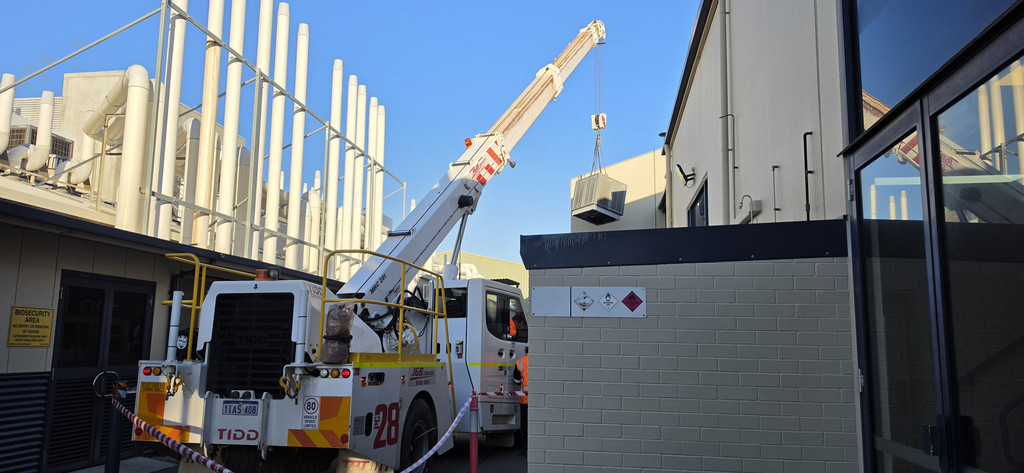
Most selections in the trade happen during a commercial evaporative cooler replacement rather than a greenfield build. Existing ductwork, roof penetrations and structural supports all limit what’ll actually fit. Those limits often outweigh the cooling capacity on paper.
What Evaporative Cooling Can and Can’t Do
Evaporative cooling can drop air temperature substantially in dry conditions, but it can’t do much when the incoming air is already humid. It works by evaporating water into the airstream, and drier air leaves more room for evaporation.
Wet-bulb temperature is the lowest temperature air can reach through evaporation alone. The gap between it and the dry-bulb reading (what a normal thermometer shows) is called wet-bulb depression. That gap sets the ceiling on what any evaporative cooler can achieve.
A direct unit in good condition typically closes roughly 75 to 90 per cent of that gap, depending on pad depth and condition. On a 40°C day with a 20°C wet bulb, supply air could land somewhere around 22 to 25°C. On a muggy 33°C day with a 28°C wet bulb, the same unit only knocks off about four degrees.
Climate Decides Whether It’s Even on the Table
Location is the first filter, because evaporative coolers only earn their keep where summer wet-bulb temperatures stay reasonably low. Field experience across Australia sorts regions roughly like this:
- Perth, Adelaide, Alice Springs, Kalgoorlie and most inland centres suit direct evaporative cooling for nearly the whole summer.
- Melbourne and Canberra work well, with a handful of sticky days each year where performance noticeably drops off.
- Coastal Sydney and Brisbane are marginal, so operators often pair evaporative units with refrigerated air or move to indirect systems.
- Darwin, Cairns and Townsville in the wet season are poor candidates, since direct units add moisture without delivering much cooling.
The useful check is the site’s design wet-bulb temperature. Plenty of disappointment in the trade traces back to someone reading the maximum summer temperature and ignoring humidity altogether.
Sizing Around Air Changes and Heat Load
Commercial evaporative coolers are sized on air changes per hour (ACH), meaning how many times the building’s air volume gets replaced each hour. Floor area alone tells half the story, since a 9-metre-high warehouse holds three times the air of a 3-metre office. Common starting points in the trade, later checked against the site’s actual heat load, look like this:
- Offices, retail and light commercial spaces often start around 20 to 30 air changes per hour.
- Warehouses and general factories commonly sit somewhere between 25 and 40.
- Spaces with heavy process heat, such as foundries, bakeries and commercial laundries, can need considerably more.
- Spot cooling for fixed workstations gets sized on throw distance and outlet velocity instead of whole-room volume.
Direct evaporative systems run on 100 per cent outside air, so they carry heat away through sheer volume. That makes relief air the factor most often forgotten. If the building can’t exhaust roughly what it takes in, the space pressurises and humidity builds up inside. Doors, relief vents or exhaust fans belong in the selection from day one.
Matching Unit Type to the Job
Unit type comes down to how much humidity the space can tolerate and how tightly its temperature needs holding. The main options each have a fairly clear home:
- Direct evaporative units suit warehouses, workshops, factories and loading docks where a bit of added moisture isn’t a problem.
- Indirect units cool air through a heat exchanger without adding moisture, which helps where paper, electronics or humidity-sensitive stock is stored.
- Two-stage (indirect-direct) units squeeze out extra degrees in marginal climates and are worth considering in coastal NSW and South East Queensland.
- Portable units handle temporary jobs, events and isolated workstations, though they cop a hammering on dusty sites and rarely last long.
One lesson that keeps repeating in the field: timber flooring showrooms, pharmaceutical storage and archive rooms tend to regret direct systems. Air leaving a direct unit is already moist, and indoor relative humidity can climb well past 70 per cent when relief air is poor. Timber swells and condensation starts showing up on cold surfaces.
Frequently Asked Questions
How Do Businesses Know if Evaporative Cooling Will Work on Their Site?
The design wet-bulb temperature for the site is the figure that matters most. As a rough guide, sites below about 21 to 22°C generally suit direct evaporative cooling. Between roughly 22 and 24°C is marginal territory, where indirect, two-stage or hybrid setups deserve a look. Much above that, direct evaporative cooling usually gets ruled out.
How Long Should a Commercial Evaporative Cooler Last?
Service life depends heavily on water quality, operating hours and maintenance. Well-maintained commercial units commonly run for many years, with pads, pumps and float valves replaced along the way. Coastal and dusty sites tend to wear units out faster.
Can a Commercial Evaporative Cooler Replacement Reuse Existing Ductwork?
Often, yes, provided the existing duct is in sound condition and suits the new airflow. New sheet metal sections or transitions are common where outlet sizes or positions don’t match. Mounting a top-discharge unit below an existing duct run, then connecting it with new ductwork, is one practical approach.
Key Takeaways
Commercial evaporative coolers are chosen by matching local wet-bulb conditions, required air changes and humidity tolerance to the right unit type and mounting arrangement. The main points hold across most Australian sites:
- Wet-bulb temperature decides whether evaporative cooling is viable before any other factor.
- Air changes per hour, plus a genuine relief air path, determine whether the space actually stays cool.
- Humidity-sensitive spaces lean towards indirect or hybrid systems.
- On replacements, discharge direction, structural support and service access often narrow the model choice.
- Water quality drives pad life and maintenance load, while hygiene obligations depend on AS/NZS 3666 and state rules such as WA’s regulations.