Commercial switchboards tend to reach their limits slowly, through years of small additions that nobody tallies up. A building’s commercial electric service is sized for the loads and standards of the day it’s commissioned. Every fitout after that assumes the original designer left enough headroom.
What It Means When a Switchboard Has Been Outgrown
A switchboard has been outgrown when its current loads or fault conditions exceed what it was designed and rated to handle safely. The limit can be capacity, physical space, protection ratings or compliance, and several often overlap.
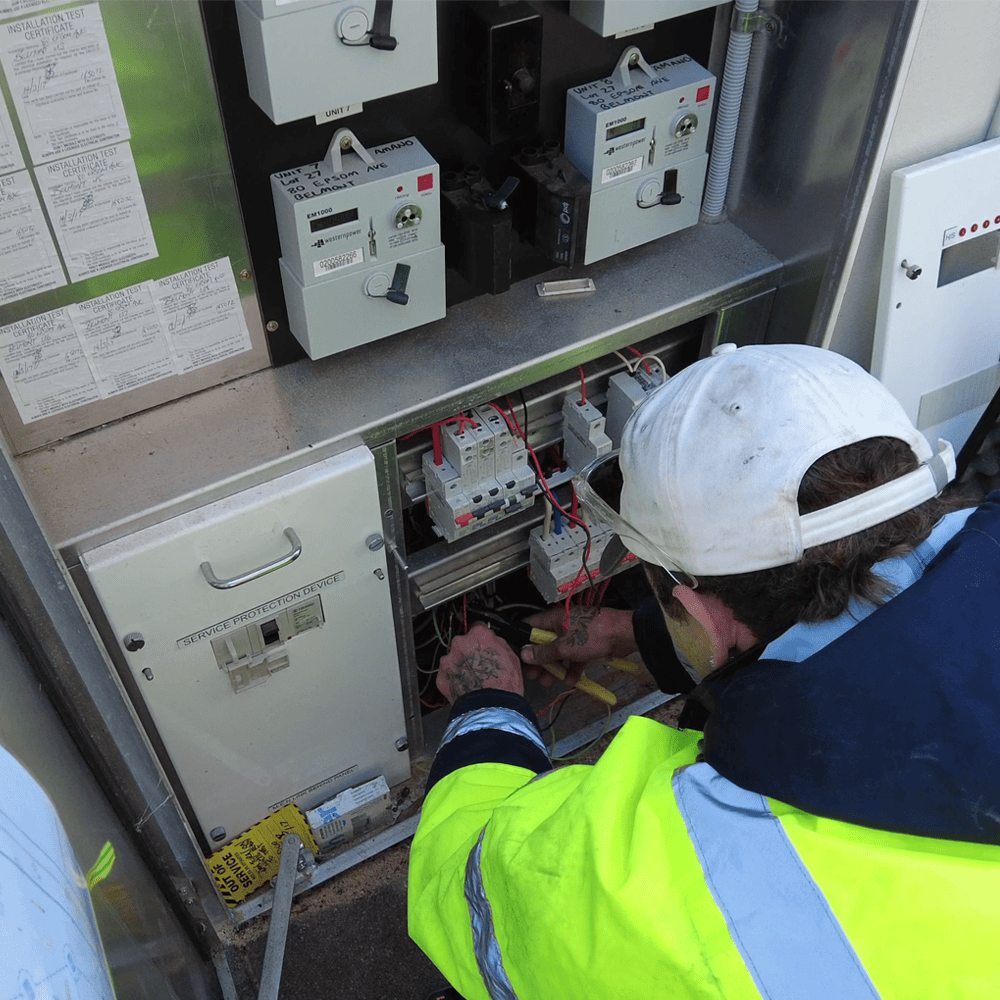
The main switchboard is the assembly where the incoming supply is split into submains and final subcircuits, each with its own protection. Its limits come from the busbar rating, the main switch, heat dissipation and the fault level it can withstand. Maximum demand is the highest load an installation is expected to draw at any one time.
AS/NZS 3000 allows maximum demand to be determined by calculation, assessment, measurement or limitation. A figure calculated in 1998 bears little resemblance to one measured today.
The Slow Load Creep Nobody Budgets For
Load creep is the gradual rise in electrical demand from tenancy changes and equipment added over years without a whole-of-building review. It’s one of the most frequent reasons commercial boards run out of room. Each contractor sizes their own job, and the cumulative total rarely gets checked. Typical contributors in Australian commercial stock include:
- Fitouts that drop a commercial kitchen, lab or server room onto a floor designed as open-plan office
- Supplementary cooling added wherever the original central plant fell short
- EV chargers, from 7 kW AC units through to DC fast chargers of 50 kW or more
- Tenancy splits, where one large lease becomes several smaller ones with separate circuits and metering
- Replacement HVAC plant that’s more efficient per kilowatt of cooling but larger in total capacity
- Lift modernisation, with drives that behave very differently on start-up
- Solar and battery systems that change how current flows through the board
A hypothetical early-1990s office block on a 400 A supply shows how this plays out. It was built for fluorescent lighting, a modest chiller and a few photocopiers per floor.
Three decades later it houses a medical imaging tenant, a café, a comms room and four EV bays. An LED retrofit along the way freed some capacity. The new loads absorbed that margin several times over.
Spare Ways Run Out Before Capacity Does
Physical space on a board often runs out well before the supply itself is exhausted. Once every spare pole and chassis position is taken, new circuits get squeezed in through workarounds. Field experience shows a familiar pattern:
- Double-terminating conductors under a single breaker terminal
- Adding a sub-board fed from an already heavily loaded outgoing circuit
- Mounting devices in cramped positions that block ventilation paths
- Relabelling circuits inconsistently, so the schedule drifts from reality
Each of these builds heat and fault risk slowly, and older boards cop a hammering as a result.
A circuit schedule with more handwritten entries than printed ones usually tells the story before anyone opens the door.
Why Modern Loads Stress Old Boards Differently
Modern electronic loads stress older switchboards through harmonic currents and uneven phase loading, which original designs rarely accounted for. Total amps can look fine on a clamp meter while the neutral and busbars run hot. Key stress points in older boards include:
- Neutral bars and conductors on boards feeding heavy IT or LED loads
- Phase imbalance from single-phase tenancy loads piled onto one phase over years
- Busbar joints torqued once at installation and never rechecked
- Enclosure temperatures, since device ratings assume a set ambient temperature and ventilation
LED drivers, variable speed drives, UPS systems and IT power supplies draw current in short pulses. On three-phase systems, third harmonic currents add together in the neutral. A reduced neutral, sized on the assumption of balanced linear loads, can end up carrying more current than any single phase.
The common line in the trade is that harmonics cook terminations long before anything trips. Thermal imaging under genuine load picks this up, and a scan at 7 am on a Sunday tells an owner very little.
Fault Levels Can Change Without Anything Inside Changing
A switchboard can become inadequate without a single new circuit, because the prospective fault current at the point of supply can rise. Network upgrades, such as a larger transformer nearby, are one common cause.
Every protective device and busbar system carries a short-circuit rating. If the prospective fault current exceeds it, a fault may not be interrupted safely. That can mean a violent failure inside the enclosure. Older boards often carry devices rated for supply conditions that no longer exist.
This rarely comes up in routine maintenance. It usually surfaces when a supply upgrade application goes to the network operator. The operator’s fault level figures sometimes don’t match the board’s nameplate. Any planned change to a commercial electric service is where that mismatch tends to show up.
Frequently Asked Questions
Can a Switchboard Be Outgrown Without Any New Equipment?
Yes, a switchboard can be outgrown with no new load at all. A network upgrade can raise the prospective fault current above what older devices are rated to interrupt. Changes to the Wiring Rules can also leave a board short of current requirements once any significant alteration is made.
Does Adding EV Chargers Require a Switchboard Upgrade?
EV chargers require a switchboard upgrade when their combined draw exceeds the board’s spare capacity. A single 7 kW AC unit usually fits within existing headroom, while several 22 kW units can exhaust it quickly. DC fast chargers of 50 kW or more typically need a dedicated submain and a review of the supply itself. Load management systems reduce the impact by sharing available capacity across chargers.
Do LED Retrofits Free Up Switchboard Capacity?
LED retrofits free up some capacity, which other additions typically absorb within a few years. LED drivers also add harmonic currents to the system. On older boards with reduced neutrals, that can increase neutral loading noticeably.
Key Takeaways
Commercial switchboards are outgrown gradually, through load creep, exhausted spare ways, harmonic stress, rising fault levels and shifting standards. Each change looks minor on its own. Together they leave a board that no longer suits the building’s commercial electric service needs.